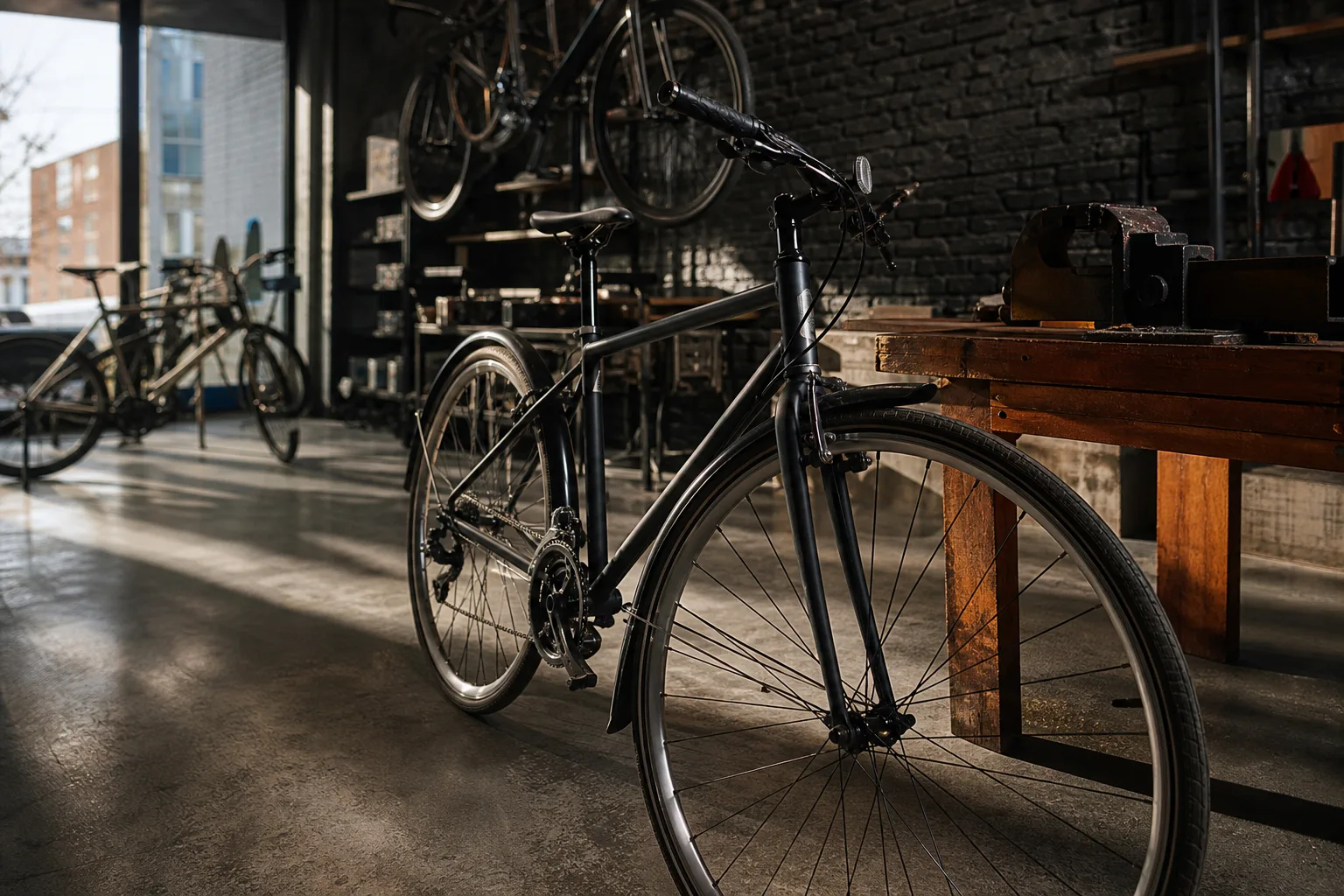
Tire clearance, low gear, brake type and bar height separate these three bikes far more reliably than the category name printed on the down tube.
The three words get used loosely enough that two bikes sold under the same one can ride nothing alike, and two sold under different ones can be near twins with different handlebars. What separates them reliably is a short list of measurements and parts: how much tire the frame will take, how low the lowest gear goes, what stops the wheel in the rain, and how far the bars sit below the saddle. Check those four and the category name stops mattering. Check none of them and the name is all you have.
Tire clearance decides what surfaces are available to you
Road bikes have widened considerably, but a frame built around 28mm rubber still cannot fit 40mm, and no amount of preference changes that. Hybrids typically land between 35 and 45mm, commuters often the same or wider with fenders already fitted, and the number worth writing down is the maximum clearance with fenders, not without. Wider tires at lower pressure absorb cracked pavement, gravel shoulders and the seam where a bridge deck meets asphalt. Narrower tires roll faster on smooth surfaces and punish everything else. Measure the gap between tire and chainstay with a finger before you decide.
Gear range matters at the bottom, not the top
Most riders never run out of high gears; they run out of low ones on a hill they did not plan for, with groceries on the rack. The check is simple arithmetic: compare the smallest chainring tooth count against the largest rear cog, and a ratio near one to one or below means you can spin up almost anything. Road bikes historically gave up that low end for tighter spacing between gears, which suits sustained speed on rolling terrain. Hybrids and commuters usually keep the low gear and accept bigger jumps, which suits stop-and-go riding with weight aboard.
Brakes, weather and the bike that lives outdoors
Rim brakes are lighter, cheaper to service and easy to adjust in a driveway, and they lose meaningful power when the rim is wet or the pads are worn thin. Disc brakes hold their stopping force in rain and on long descents, and hydraulic versions need far less hand strength than mechanical ones, which matters on a commute with a dozen traffic lights. The Consumer Product Safety Commission oversees braking and reflector requirements for bicycles sold in the United States. If the bike sleeps at a rack outside, ask what the pads and rotors cost, and whether a shop nearby stocks them.
Riding position is set by stack, reach and bar height
Drop bars are not automatically an aggressive position and flat bars are not automatically an upright one; the frame's stack and reach set the baseline, and the spacer stack under the stem adjusts it by an inch or so either way. Road geometry usually puts the bars below the saddle, loading the hands and opening the hip angle for power over distance. Hybrid and commuter geometry raises the front end, shortens the reach, and shifts weight onto the saddle, which is comfortable for an hour and visibility-friendly in traffic. Sit on all three before ranking them.
Weight, mounts and the parts of ownership nobody photographs
A bike carried up two flights of stairs every night is a different purchase than one rolled into a garage, and four pounds you can ignore in a parking lot become the deciding factor on a landing. Look for threaded eyelets at the dropouts and seatstays, since a frame without them limits you to clamp-on racks and fenders that rattle loose. Check whether the wheels use quick-release skewers, which come off in seconds with no tools, or through-axles and bolts, which do not. That difference shapes how you lock it and what you take inside.
Bring a tape measure, a phone for photos of the numbers stamped on parts, and a written note of the terrain you actually ride. Shops answer specific questions well. The bike that fits is usually the one where the four checks line up with the route, not the one whose category name matched the plan you had in mind walking in.